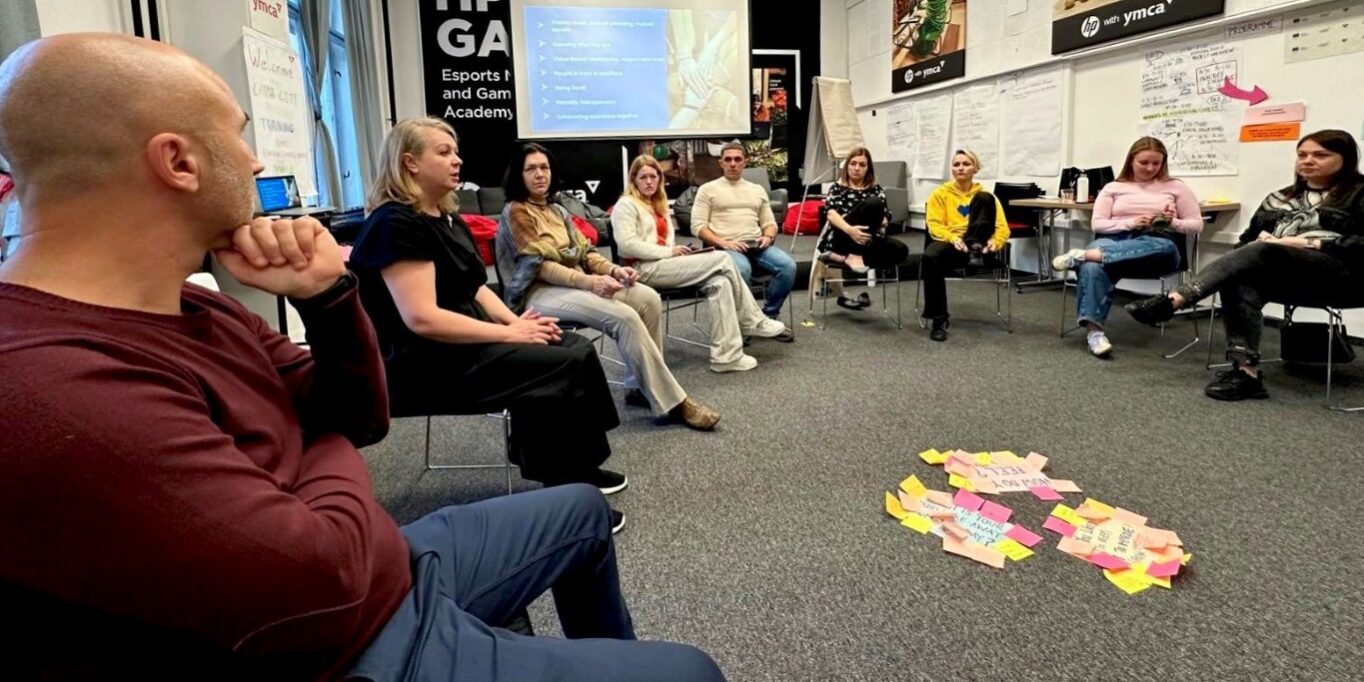
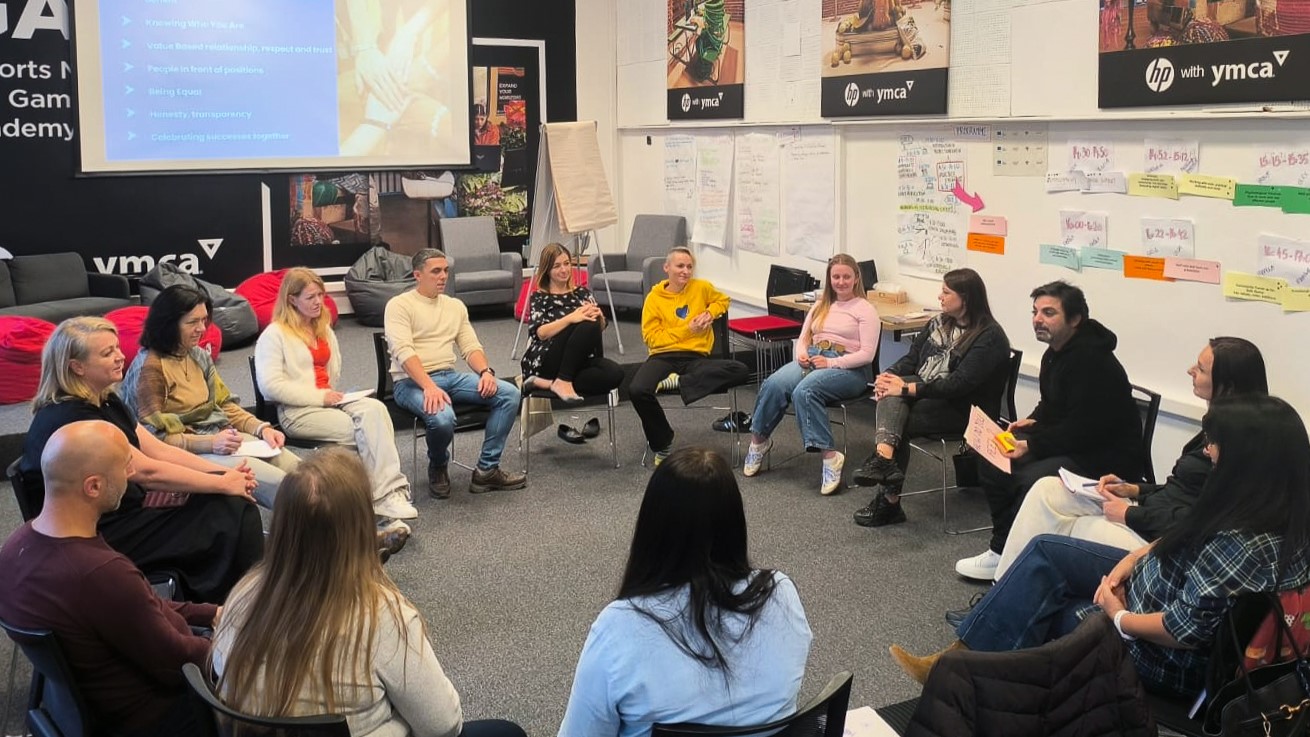
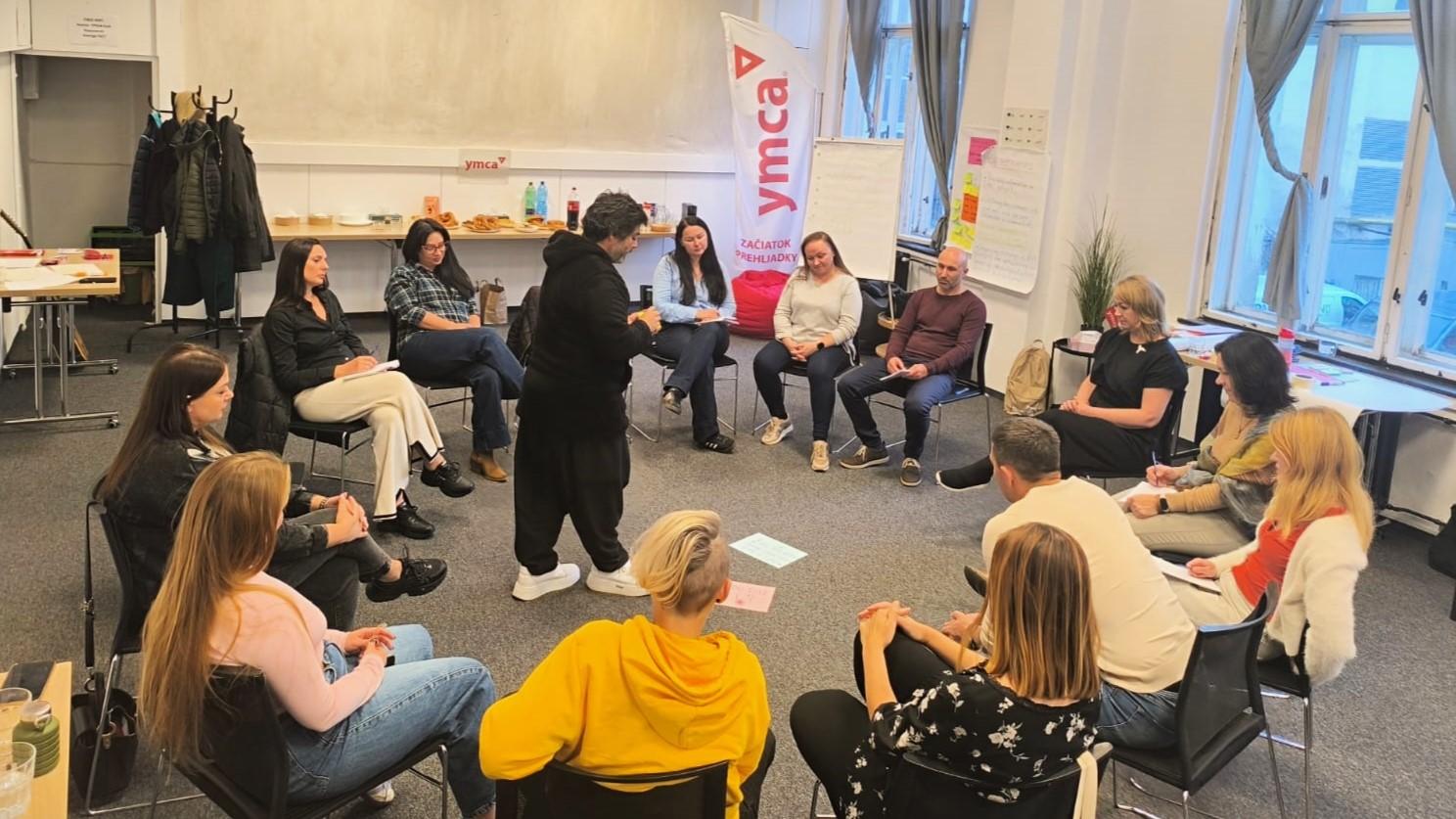
The Capacity Building Training “Educational Hubs and Mobile Centers (EHMC)” took place in Bratislava from 17 to 20 October 2025, bringing together representatives from YMCAs in Romania, Slovakia, and Germany.
As a key component of the broader EHMC project, the training aimed to enhance the capacity of local hubs supporting Ukrainian refugees through community-based learning, stakeholder cooperation, and shared best practices.
The event brought together 13 professionals—including psychologists, child-care providers, employment officers, and community leaders—most of whom were refugees from Ukraine. Their lived experience enriched the discussions and shaped the collective learning atmosphere.
Objectives Focused on Real Needs
The training set out to:
- Present the EHMC project framework and research on refugees’ needs;
- Strengthen participants’ skills in stakeholder engagement;
- Deepen awareness of intercultural work and ethical considerations;
- Facilitate the exchange of best practices in psychosocial support, child care, and employment;
- Build cross-country cooperation through networking and peer learning.
These objectives were informed by a pre-training needs assessment, where participants highlighted specific areas they wanted to strengthen—such as trauma-informed practices, safe space creation, nonviolent communication, burnout prevention, facilitation tools, IT and language courses, creative methods, and ways to attract community members to center activities.
The trainers used this input to tailor the programme.
Expert Training Team
The sessions were facilitated by two experts:
Cihan Kilic, an international non-formal education trainer and Secretary General of VOICIFY, brought extensive experience in migration, youth participation, and human rights education. His work with the Council of Europe, UNHCR, and refugee-led initiatives provided deep insight into intercultural cooperation and ethical engagement.
Olga Lukina, YMCA Europe Executive Secretary for Strategy and Movement Strengthening, contributed 25 years of expertise in governance, organisational development, and leadership education. As the EHMC project coordinator, she ensured the learning remained closely connected to project goals and local realities.
Programme Overview: From Shared Understanding to Practical Action
The training followed a non-formal education approach, guiding participants through a carefully structured learning journey.
Day 1 – Foundations, Stakeholders, and Best Practices
The opening sessions built trust, clarified expectations, and aligned participants around the EHMC vision. Through team-building activities and stakeholder mapping, participants moved from individual motivations to collective responsibility.
The “Best Practices Exchange” showcased diverse methods for psychological support, child-friendly approaches, employment support, and community outreach. The day concluded with group reflection to consolidate learning.
Day 2 – Intercultural Competences, Ethics, and Networking
A simulation on intercultural collaboration helped participants explore communication styles, cultural norms, and hidden assumptions. This led seamlessly into a powerful session on ethical dilemmas, where participants worked with real-life cases from their own practice.
An Open Space session allowed participants to drive the agenda themselves, focusing on topics such as nonviolent communication and the future of Ukrainian refugees after March 2027.
Networking activities provided space for one-on-one conversations, idea-sharing, and future cooperation planning.
The day ended with the development of individual action plans, a final evaluation, and a collective reflection on next steps.
Results and Key Achievements
The training achieved several important outcomes:
- A strengthened shared understanding of the EHMC project across three countries.
- Increased motivation and a reinforced sense of community among participants.
- Enhanced skills in stakeholder mapping, partnership building, and community outreach.
- Improved awareness of intercultural communication and ethical decision-making.
- Exchange of tools and methodologies for psychosocial support, education, and facilitation.
- Development of concrete action plans for integrating new practices into local hubs.
- Higher awareness of structural challenges, including cooperation with local authorities and gaps in mental health insurance.
Participants emphasised gaining new methods, practical tools, project ideas, and peer support—highlighting the value of cross-country learning.
Trainer Observations: A Strong Learning Community Emerges
The trainers reported exceptional levels of participation, openness, and constructive dialogue.
Participants demonstrated:
- high motivation,
- deep empathy rooted in lived experience,
- professionalism,
- and strong readiness to transfer learning into practice.
The group quickly developed into a cohesive learning community, capable of reflective discussions and meaningful peer support. The exchange of best practices across delegations showed a high degree of knowledge co-creation. By the end of the training, participants were confidently articulating new insights and planning next steps, illustrating both individual growth and collective maturity.
Evaluation Feedback: High Satisfaction and a Desire for More
All 13 participants provided detailed feedback, expressing strong appreciation for the structure, facilitation style, and practical relevance of the sessions. Many described the training as highly professional, inspiring, and emotionally supportive.
Participants especially valued:
- ethical dilemmas discussions,
- networking opportunities,
- practical group exercises,
- tools transferable to their daily work,
- the sense of belonging and teamwork.
Overall, participants expressed a desire for continued collaboration and more opportunities to meet in person.
Impact Within the Larger EHMC Project
The training served as a crucial milestone for the Educational Hubs and Mobile Centers initiative:
- It aligned standards, expectations, and practices across hubs in three countries.
- It strengthened the professional and interpersonal networks essential for sustainable cooperation.
- It enhanced the competence of frontline workers supporting Ukrainian refugees.
- It grounded the project in shared values of participation, human rights, and ethical engagement.
- It enriched local hubs with new methods, psychological tools, and community-building approaches.
- It increased resilience and cohesion across the international partnership.
Most importantly, the training reinforced the project’s long-term mission: to create community-driven, inclusive, and responsive spaces where refugees are not passive recipients of support, but equal participants in building capable and connected communities.
Part of the “eDU Hubs and Mobile Centres” project, supporting the integration of Ukrainian refugees and host communities. Co-funded by the EU (ESF+ Social Innovation+) and Accenture.